Tattoo Removal Treatments in
Pittsburgh, Pennsylvania
Tattoo Removal
Welcome to Advanced Laser
Tattoo Removal! We are
Pittsburgh’s expert in
effective laser tattoo
removal. We offer a free
consultation and use the
best technology to remove
your unwanted tattoo. Our
professional medical staff
is especially educated and
experienced in tattoo
removal to give you the best
results possible.
So you wanted
a Tattoo………..
Years ago you may have made
a decision that would last a
life time, have regrets
now?? If so we are here to
help!
We have trained certified
laser technicians that can
help remove that unsightly
tattoo:
whether it be an
ex-boyfriend/girlfriends
name
permanent tattooed
wedding band
dare on a night out with
some friends
youreceived
unsatisfactory art work
from a not so
experienced tattooist?
Amateur tattoos are just
that…….amateur!
Non-trained individuals
will use inferior ink,
like that found in a
ball point pen to make
the tattoo. These
tattoos usually respond
well to laser energy.
Traumatic tattoos are
not uncommon, people
have all sorts of
traumatic injuries that
result in the placement
of pigments into the
dermis. Ex. includes car
accidents, falls,
getting jabbed with a
pen or pencil. These
tattoos usually respond
well to laser energy.
Etc….
Want a cover up with more
pristine art? We can fade
your old tattoo to make it
easier for your new artist
to make your new piece.
Possibly you may want to do
your next one “right” – (on
certain areas) you may want
Permanent Hair Removal on
the surface first (so that
the hair doesn’t distract
the artwork).
No matter what the issue, we
are here to help.
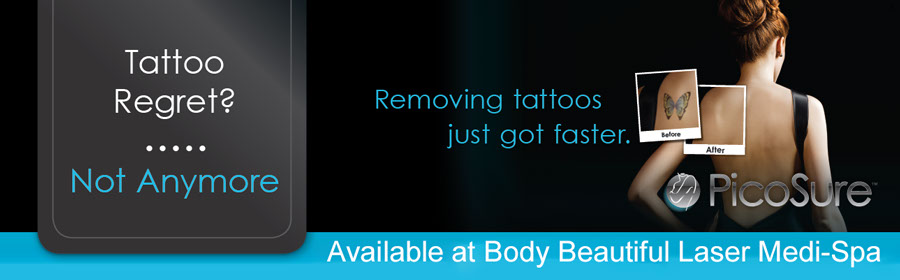
The New r20 Technique Cuts
Laser Tattoo Removal Time in
Half
Nineteen-year-old Amanda
McDonald had no regrets when
she got a tattoo of a star
on her arm. But at 39, the
stay-at-home mom believed
the youthful design wasn’t
right for her anymore. “My
life has changed
dramatically since I was
younger,” Amanda said. “It
just doesn’t fit me anymore.
I want to be able to wear
tank tops and dresses, and
feel comfortable with
myself.”
Amanda considered tattoo
removal, but knowing it
could take over a year to
complete, she settled with
covering up with long
sleeves, sweaters and
jackets. But then, she heard
about a new procedure that
is able to remove tattoos in
a fraction of the time. So
Amanda made an appointment
with Wesley South, a
certified laser technician,
at Body Beautiful, who
performs the procedure.
Called the r20 technique,
its results can be seen in
just one session. Tattoos
that normally would take
four treatments to remove
now only require one;
tattoos that would need
eight sessions, now only
require two – and so on.
What was done in four
months’ time, can be done in
one day now. Clients are
getting much faster results
and when it's faster, it is
easier to make the
appointment to come in. The
one thing that really
discourages clients from
getting tattoo removals is
that they are told that it
can sometimes take one to
two years to clear a tattoo.
Now, it can be done in just
a few months!
On the first pass of the
laser, the entire tattoo is
traced. Gas bubbles form and
dissipate. Twenty minutes
later, the area is able to
be penetrated deeper for the
second pass of the laser.
Four passes of the laser can
be done in one treatment
session.
Consider calling Body
Beautiful Laser Medi-Spa to
make an appointment for
Tattoo Laser removal. One of
our certified laser
technicians will be happy to
speak with you and answer
any questions about r20 or
any of our other services.
How it works
With the newest, most
effective tattoo removal
system.
Laser tattoo removal works
by a process called
Photodisruptive; it is the
newest technology and has
better results with fewer
treatment complications. How
photodisruption works is
that it causes a micro
implosion under the skin
that breaks down the tattoo
ink into small particles
that the body can exfoliate
or expel (much the same way
a bruise dissipates over
time). The microscopic
explosion will displace the
ink into the epidermis in
which case it will be
naturally sloughed off
because of cellular
turnover.
The energy is targeted
towards the carbon particles
or dyes that are found in
skin tattoos, allowing
selective destruction of the
foreign pigment while
minimizing damage to the
surrounding skin.
Therefore breaking up the
pigment/color in your
tattoo. Over the next days
and weeks the body’s immune
system will flush away the
broken down ink.
Procedure
Over the past few years,
technology has advanced to
allow us to remove tattoos
in a series, of 5-30 minute
treatments. This allows you
to get in and out quickly,
as to not interfere with
your busy schedule.
We also offer the R20
technique (a recently
published study in the
American Academy of
Dermatology introduced a
revolutionary method of
removing tattoos with only
one or two treatments. The
new method, referred to as
the R20 method, uses the
Q-switched laser in an
alternative way).
Instead of only completing
one pass of the laser during
the office visit, there are
several passes used to treat
the tattoo during the
same visit. The passes
are completed with a twenty
minute rest in between
treatments. Immediately
after the treatment pass,
there is a whitish
appearance of tiny bubbles
produced on the surface of
the tattoo. The laser cannot
target the tattoo through
this whitening, so the
twenty minute break between
treatments is necessary for
the whitish bubbles to
disappear. After twenty
minutes, the whitish
appearance has resolved and
the laser can once again
target the pigment of the
tattoo. The R20 method of
completing multiple tattoo
removal treatments during
one office visit allows the
laser to reach greater
depths that with one single
pass of the Q-switched
laser. In clinical studies,
one treatment was sufficient
to nearly clear a tattoo of
black ink. The R20 method of
tattoo removal is effective
and safe; there were not
increased side effects seen
with the new method of
treatment.
What’s another option for
removing my tattoo?
For pre-treated, lighter,
more faded tattoos, we may
recommend using our
solution method. This
works by implanting the
solution (much like
implanting ink) with a
tattoo needle. Thus,
allowing solution to liquefy
implanted ink and your body
quickly responds by pushing
solution and ink to the
surface of your skin.
Regardless of the color
the tattoo is, the surfacing
color will look brown. You
can actually see color wipe
away! It is VERY important
to keep the treated area
very clean! The color should
scab on the surface as a
natural protective barrier,
but you are also instructed
to apply bacitracin ointment
and bandage over the area
for more protection. Treat
this area like a wound that
needs tended to. Use your
judgment if the area seems
to soggy from ointment then
let it safely air dry when
you can. The objective is to
let the “pigmented scab” dry
out like a crust and
slowly slough off. As
it sloughs off, it will take
that bit of color with it.
DO NOT try to pick it
off!!! You do not want to
risk getting germs in the
wound, making it bleed,
prolonging healing time or
risk scarring.
You may need more treatments
depending on how much
pigment YOUR body releases
each time. Blue and Green
colors seem to be a little
more stubborn to release.
What is laser tattoo removal
and who is a candidate for
getting this procedure?
The removal of tattoos is
achieved by Selective
Thermolysis- (chemical dissipation by
means of heat-which
basically evaporates your
tattoo). Lasers deliver
energy targeted toward the
carbon particles or dyes
found in the tattoo. This
allows the foriegn pigment
to be selectively destroyed
while minimizing damage to
your skin.
These lasers can be used on
all tattoos, whether they
were from medical
procedures, injuries,
homemade or professionally
done. Although each tattoo
color responds differently
to treatment by tattoo
removal lasers, anyone is a
good candidate for laser
tattoo removal.
What kind of laser is used
for this procedure?
Q-switched laser. This
stands for ‘quality-switched
laser’ and refers to the
fact that this laser targets
short pulses of light energy
at a tattoo which cracks
open the pigments. Your skin
has cells called
‘macrophages’ which are able
to remove these broken down
pigments from the tattoo.
These lasers are effective
at targeting the tattoo with
minimal or no damage to the
surrounding skin.
PRICE
At Advanced LTR–Body
Beautiful, we are committed
to offering the best laser
tattoo removal at a
reasonable price. You may be
surprised how affordable the
treatment actually is!
Years ago, the same
procedure would be less
effective and costs tens of
thousands of dollars. Today
we are able to make tattoo
removal less expensive.
During your
complimentary initial
consultation your tattoo
will be examined and a price
per treatment and estimated
number of treatments
required will be provided.
It is also important to note
that many tattoo removal
centers use less expensive
and less powerful
'all-in-one' laser systems
which in many cases require
twice as many treatments
than would be required using
the more powerful –accurate
laser systems available at
Advanced Tattoo Removal.
Cost of the new R20 Tattoo
Removal?
Traditional tattoo removal
costs $400 per session for a
medium 4-8 inche. The R20
method allows four
treatments to be performed
in one session, and requires
only one to three sessions
total. The price of one R20
session, usually $1600, is
currently on special but a
consult is recommended
first, 724 987 3221
Frequently asked questions
What do you use to remove a
tattoo?
Advanced LTR –Body Beautiful
uses an advanced tattoo
removal laser – Medlite Hoya
Con Bio. This Q-switched
Nd:YAG laser is highly
effective at removing a wide
range of colored ink.
How exactly does the laser
break up the tattoo ink?
Two key processes break up
the ink - the pigment in
your tattoo will absorb the
energy from the laser and
break apart; also, the
incredibly fast pulse and
energy of the laser will
cause the ink to shatter
–break down like a sugar
cube breaking apart. Some
colors (light blue, light
green, and teal/turquoise)
are difficult to remove
completely and patients
should expect that no more
than 70-80% of this ink can
be removed unless the tattoo
is very old (20 years or
more). The TriWave is more
effective than any available
laser at breaking down a
considerable amount of this
ink when used by a
highly-trained laser
specialist.
How does the body remove the
shattered ink?
Once the ink is broken down
by the tattoo removal laser,
the body will respond by
moving fluid to the area to
help flush away the ink.
This immune-response will be
obvious to the patient in
the form of some swelling
and redness in the area.
Over the next days and weeks
the ink will be flushed
away. This doesn't happen
overnight. Removing a tattoo
takes a number of sessions.
Why do I need multiple
sessions?
All tattoos layers of ink,
stacked on top of each other
and a thick concentration of
pigment particles that
cannot be completely broken
down in one session. At
Advanced LTR, we'll go over
your entire tattoo with the
laser, breaking up as much
ink as possible in every
session. Each session will
produce some level of
fading, although for very
new tattoos the fading may
not be as visible because
the ink is still so thick
and dense. If your tattoo
has shading, it will be
removed with some degree of
ease because shading is just
a tattoo without much ink
density. It may only take a
few sessions to remove this
shading.
Does it hurt?
Patients describe the
feeling as a rubber band
slapping off your skin. Many
say it is actually less
painful than getting the
tattoo in the first place
and takes just minutes.
What should I expect after
getting this procedure?
You may experience swelling
or a blister for the first
few days after the treatment
as well as white scabbing
immediately following.
Continued lightening of the
tattoo can be observed for
4-8 weeks after each
treatment. Treat with an
antibiotic ointment to aid
the healing process and
prevent infection. Take
something along the lines of
Tylenol for pain and elevate
the treated area to prevent
swelling. Make sure to stay
out of the sun. Pigmentary
changes may occur following
laser treatment-so it is
possible that your skin may
either lighten or darken.
The latter is more common
following sun exposure.