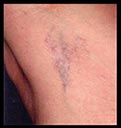
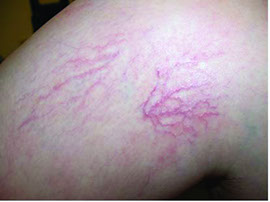
Spider veins are
tiny red or purple
dilated blood
vessels that form
when veins become
enlarged and swollen
with stagnant blood.
Though smaller than
most varicose veins,
spider veins are
often darker and
more noticeable.
This is because
these veins are
located just below
the surface of the
skin.
More common in
women, spider veins
may be triggered by
pregnancy or
hormonal variations
and sometimes result
in itching, restless
leg and minor aches
and pains.
Non-symptomatic
spider veins may be
found on the face
and chest as well as
the legs. Although
surface veins are
mainly a cosmetic
problem, they can
also be an
indication of more
serious vein disease
deep below the
surface.
Treatment
Spider veins can be
treated with
injections, surgical
removal and laser
surgery. You should
discuss these
treatments with our
vein specialist
to determine the
best choice for your
personal situation.
The 1st step of our
3step Leg
Rejuvenation Program
is having a Doppler
Ultrasound at our
ACR (Americam
College of
Radiology)
accredited site.
This is performed by
an RVT –
Registered Vascular
Technician or
call 724-987-3220
for a free
consultation today
Lose Spider Veins in a Flash
with Intense Pulse Light
Therapy
As you age, developing
spider veins, age spots, and
broken capillaries is
unfortunately part of the
process. Just because they
are natural, does not mean
that you are stuck with
these unattractive
discolorations on your face,
chest and legs forever. One
of the fastest and safest
ways to get rid of spider
veins and similar
discolorations is through
the use of a revolutionary
new technology –intense
pulse light therapy. Large
areas can be treated quickly
and easily, with less
damage. IPL targets spider
veins and discolorations
deep below the surface of
the skin while leaving the
outer layer of the skin
undamaged.
An alternative to
Pulsed Light is
Sclerotherapy-
injections of
solutions into your
spider veins .Our
doctors perform the
procedure in the
office and
administers the
injection with a
small needle and
syringe. The
solution scars the
veins and causes
them to collapse,
hiding their
appearance.
What Is a Varicose
Vein Vs. a Spider
Vein?
Though
people use
the terms
varicose
veins
and
spider veins
interchangeably,
this is
incorrect.
Varicose
veins
are the more
serious of
the two and
lead to
surgery more
often. Both
conditions
can escalate
from a mild
to severe
case.
Varicose
veins are
large
bulging and
twisted
veins that
are dark
purple or
blue. They
typically
affect the
leg area and
are more
common in
woman than
men. People
that suffer
from spider
veins have
similar
contributing
factors.
Genetics and
the fact
that at
different
times during
a person's
life, such
as puberty
and
menopause,
cause an
increase in
the
production
of hormones.
This can
result in a
weakening of
the vein
walls. As
you become
older, the
valves in
the vein
walls begin
to fail,
resulting in
the veins
stretching
and
breaking.
Eventually,
spider veins
appear.
Restless Leg
Syndrome Associated
With Spider Veins
A variety of factors
may cause restless
leg syndrome and
spider veins.
However, in some
cases, restless leg
syndrome associated
with spider veins
may be attributed to
dysfunction of the
veins in the legs.
Restless Leg
Syndrome (RLS)
refers to a
condition in which a
person experiences
unpleasant
sensations in the
legs when they are
at rest. People with
RLS may find it
difficult to sit
still, and they may
have trouble
sleeping due to the
urge to move their
legs. Restless leg
syndrome is a
commonly associated
with the presence of
spider veins.